0 0 9: Common Patterns and What They Mean
0 0 9: Common Patterns and What They Mean
If you searched for 0 0 9, 0 0 9 0, 0 0 9 1, 0 0 0 9, or 1 0 0 9, you’re probably not looking for elementary math. You’re trying to understand why these values show up in systems, files, identifiers, schedules, logs, or structured data.
In practice, patterns like these rarely have a single universal meaning. Their interpretation depends on context:
- a padded number in a database
- a fixed-width code in a legacy system
- a binary-like or positional pattern
- a schedule or status sequence
- a machine-generated identifier
- an OCR or formatting artifact
This guide breaks down the most likely interpretations, explains where these patterns commonly appear, and shows how to investigate them correctly without guessing.
"67% of U.S. office workers feel they are constantly performing repetitive tasks, averaging 4.5 hours per week on activities they believe could be automated." - UiPath
That matters here because odd recurring values like 0 0 9 often surface inside exactly those repetitive workflows: exports, monitoring alerts, ETL jobs, scheduled summaries, and log reviews. Instead of manually checking them every day, teams increasingly automate the interpretation layer.

What does 0 0 9 usually mean?
The short answer: it usually means a structured value, not a symbolic message.
When people see 0 0 9, they often assume it must be a hidden code. Most of the time, it’s simpler than that. It is often one of these:
Pattern | Most likely interpretation | Common places it appears |
|---|---|---|
| Zero-padded small integer or segmented code | Logs, exports, serial fields, OCR text |
| Fixed-length code with placeholders | Product IDs, batch records, machine output |
| Sequential variation of padded code | System identifiers, queue items, records |
| Stronger left-padding for width consistency | Databases, invoices, CSVs, ERP systems |
| Positional value, ID fragment, or year-like code | Report fields, legacy systems, numeric keys |
The important point is this: spaces do not necessarily mean separate numbers. They may reflect formatting from:
- copied PDFs
- OCR extraction
- print layouts
- column-based exports
- old terminals
- badly parsed text
So 0 0 9 may actually mean:
0090,0,90-0-9- three separate fields
- a visual alignment artifact
Why these patterns appear so often in technical systems
Systems love fixed-width formatting. Humans prefer flexible formatting, but machines often don’t.
To keep sorting, matching, and parsing consistent, software frequently stores small values with leading zeros:
9becomes00990becomes009091becomes0091
This is common in:
- database primary or display keys
- ticket numbers
- file sequence counters
- batch job outputs
- invoice and order references
- device or sensor records
- legacy COBOL or mainframe exports
Leading zeros are usually structural, not mathematical
Mathematically, 009 equals 9. But operationally, 009 and 9 may not be treated the same.
For example:
- lexical sorting differs
- field width validation may fail
- integration rules may require exact character counts
- downstream systems may expect a string, not a number
That’s why values like 0 0 0 9 often matter in pipelines even when they look trivial.
The most likely meanings of each query pattern
0 0 9
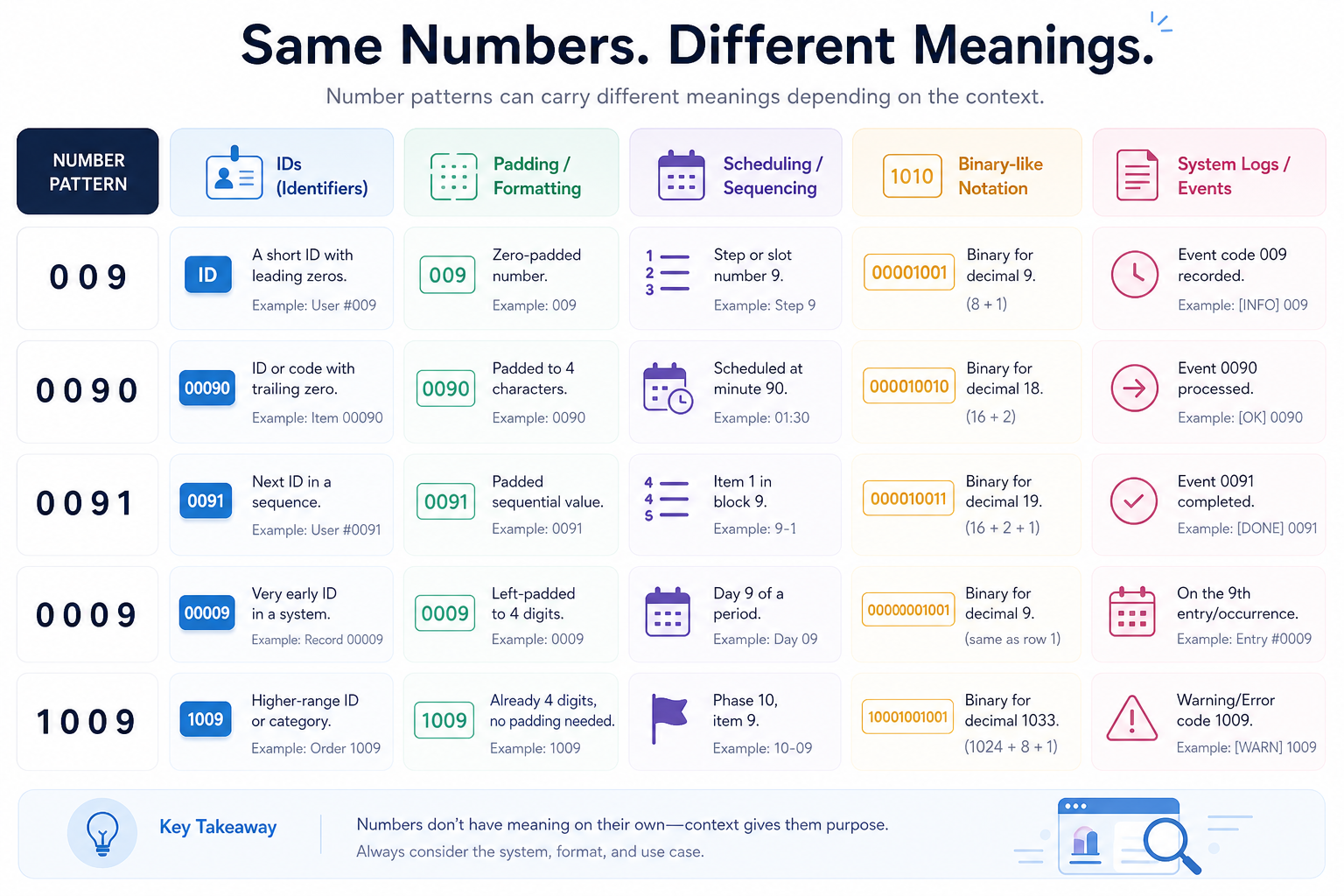
0 0 9 most commonly resolves to 009.
Possible meanings:
- Zero-padded identifier
A record number or sequence count where width matters. - Three-field structured value
It could represent three positions, such asgroup=0,subgroup=0,item=9. - OCR or copy artifact
A PDF or scan may have separated digits that originally belonged together. - Position-based encoding
In custom systems, each digit may represent a status flag or category level.
Practical interpretation
If you see 0 0 9 in a log, spreadsheet, or app export, first test whether the source intended:
0090/0/9- three columns merged into one display
0 0 9 0
0 0 9 0 usually maps to 0090 or a 4-position code.
Common interpretations:
- fixed-width numeric ID
- category-position-status-position format
- low-value sequence counter
- line item number padded for alignment
This type of pattern often appears in systems that enforce 4-character values, especially when earlier values are sparse.
Example
A warehouse or ERP system may store:
0001000200350090
When exported poorly, 0090 may appear as 0 0 9 0.
0 0 9 1
0 0 9 1 usually suggests 0091, which is often just the next value after 0090.
That makes it especially likely to represent:
- a sequential identifier
- an incremented item number
- a counter in a scheduled job
- a batch or run sequence
Why 0091 matters more than it looks
If 0090 and 0091 appear together, you’re likely dealing with ordered records, not symbolic numerology. That distinction matters when troubleshooting missing rows, skipped runs, or duplicate outputs.
0 0 0 9
0 0 0 9 is a classic left-padded single-digit value. It most often means 0009.
This usually appears when a system enforces a 4-digit minimum width, such as:
- order numbers
- invoice counters
- machine cycles
- inventory slots
- record display IDs
Of all the patterns here, this one is the clearest example of formatting over meaning.
1 0 0 9
1 0 0 9 is more ambiguous than the zero-led patterns.
It may mean:
1009as a standard number- a year-like value in shorthand
- a 4-digit code
- four separate fields:
1,0,0,9 - a binary-style flag group with decimal digits
Unlike 0009, this value may already be "significant" without padding. So the best question is not “what does 1009 mean?” but rather “what field is this from?”
The key content gap most articles miss: context beats pattern matching
Many articles about number patterns stay too abstract. They explain sequences in pure math, but they don’t help when a user encounters a value in the real world.
That’s the missing piece: operational context.
When you see a pattern like 0 0 9, the correct workflow is:
- identify the source
- determine whether spaces are meaningful
- check field width rules
- inspect neighboring values
- confirm whether it’s numeric, textual, or segmented
- trace where the value is produced and consumed
That approach is more useful than trying to assign a universal meaning.
"Pattern recognition is fundamental in computing and mathematics, enabling systems to identify and interpret data structures, which is essential for applications like machine learning and artificial intelligence." - TechTarget
How to decode a number pattern correctly
1. Check whether the spaces are real
Ask:
- Was this copied from a PDF?
- Was it extracted by OCR?
- Did a CSV import split digits incorrectly?
- Is the UI using spaced typography?
If yes, 0 0 9 may simply be 009.
2. Look at neighboring values
Context from adjacent values is often enough.
For example:
Neighboring values | Likely interpretation |
|---|---|
| Sequential padded numbers |
| Four-digit incrementing sequence |
| Numeric series or code block |
Mixed values like | Structured alphanumeric field |
3. Determine whether it’s stored as text or number
This is critical.
If it is stored as a number:
- leading zeros may be cosmetic only
If it is stored as text/string:
- leading zeros may be required and meaningful
4. Map the field width
Try stripping spaces and counting digits:
0 0 9→ 3 digits0 0 9 0→ 4 digits0 0 0 9→ 4 digits1 0 0 9→ 4 digits
That often reveals whether the pattern belongs to a 3-digit or 4-digit code family.
5. Trace the generating system
Ask where it came from:
- database export
- monitoring tool
- billing system
- scheduler
- security report
- OCR scan
- device firmware
- integration middleware
The generator often defines the pattern.
Common technical contexts where 0 0 9-style values appear
Logs and monitoring output
Systems frequently emit counters, status fields, or incident IDs with zero-padding. This makes alignment easier across large text outputs.
Example:
run_id=009error_code=0090alert_seq=0091
CSV and spreadsheet exports
Older exports may preserve display formatting rather than raw values. If spacing or encoding breaks, grouped digits can appear separated.
Database display keys
A database may internally use integer 9, but the UI may display 0009 for consistency. Exports sometimes preserve the UI format, not the raw schema.
Scheduling and automation systems
Recurring workflows often produce numbered runs:
- run 009
- run 090
- run 091
This is especially common in automated reporting, briefs, checks, and daily summaries.
Legacy enterprise software
ERP, finance, and inventory systems often rely on fixed-width numeric strings because older integrations expect exact positions.
Could these patterns relate to binary, octal, or positional systems?
Sometimes, but not usually.
Binary?
No. Binary uses only 0 and 1, so values containing 9 are not binary.
Octal?
No. Octal uses digits 0 through 7, so 9 disqualifies it.
Decimal positional notation?
Yes. These values are fully valid in decimal notation.
Segmented positional encoding?
Possibly. Some systems use each digit position to represent a class, flag, region, or status. In that case, 0 0 9 1 could mean something like:
- class 0
- region 0
- status 9
- subtype 1
But that meaning would be system-specific, not universal.
What these patterns do not usually mean
To save time, here’s what not to assume first:
- not automatically an angel number
- not inherently a security threat
- not necessarily a mathematical sequence
- not necessarily an error code standard
- not a universal telecom or country code interpretation
- not a binary pattern
The same digits can mean totally different things depending on source format.
A quick comparison table for fast interpretation
Query | Most probable raw form | Most probable meaning | Confidence |
|---|---|---|---|
|
| Zero-padded sequence or ID | High |
|
| 4-digit padded code or record number | High |
|
| Sequential 4-digit record or run ID | High |
|
| Left-padded single-digit identifier | Very high |
|
| Standard 4-digit number or code | Medium |
If you keep seeing these values, automate the investigation
This is where teams waste time: the same weird value appears in logs, tickets, dashboards, or reports, and someone manually checks it again and again.
A better approach is to automate interpretation.
For example, you can create a recurring workflow that:
- pulls logs or records from connected tools
- detects patterns like
0 0 9,0091, or0009 - normalizes formatting
- explains likely meaning
- sends a summary to your team on a schedule
That’s a practical fit for runprompt.
With runprompt, you can build AI-powered recurring checks without maintaining infrastructure or writing custom scheduler code. You write the prompt, connect tools through MCP servers, define a cron schedule, and let the platform run it automatically.
Why runprompt fits this use case
- No infrastructure to manage
- No coding required for basic recurring automations
- Easy cron-based scheduling
- MCP server support to connect external tools and APIs
- Encrypted secrets handling for tokens and keys
- Sandboxed isolated execution for safer automation
- Transparent logs and run history for debugging
- Multiple model tiers for cost and quality control
- Fast setup for briefings, monitoring, reporting, and security checks
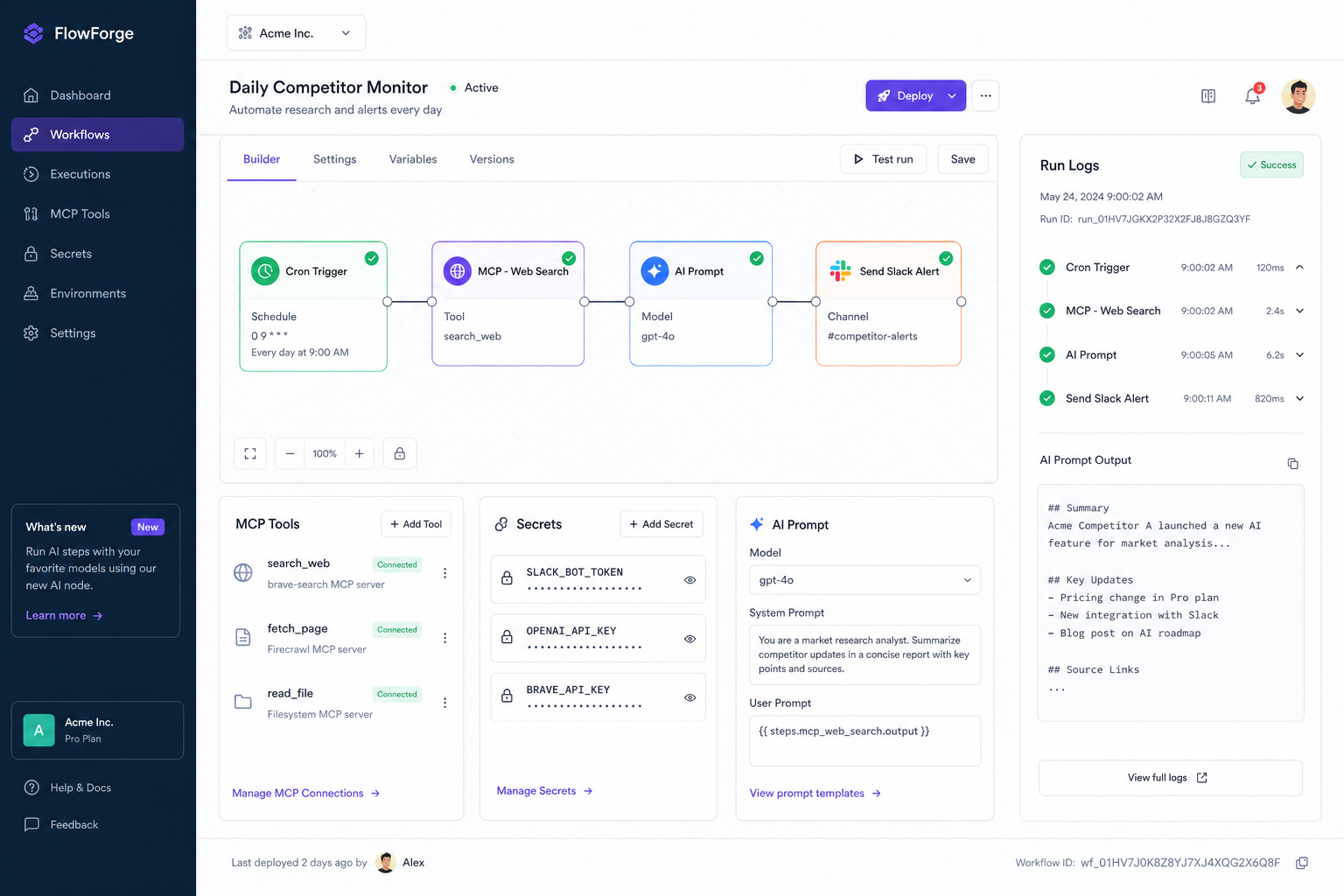
Example automation idea
A useful prompt in runprompt could say:
Review today’s logs and exported records. Detect patterns like0 0 9,0 0 9 0,0 0 9 1,0 0 0 9, and1 0 0 9. Normalize them into likely raw forms, explain whether they appear to be padded identifiers, segmented fields, or formatting artifacts, and flag any unusual sequence gaps.
This is exactly the kind of lightweight AI automation that saves technical teams from repetitive review work.
Example interpretation scenarios
Scenario 1: CSV export from an ERP system
You see:
0 0 0 90 0 1 00 0 1 1
Interpretation:
- Almost certainly
0009,0010,0011 - This is a padded sequence field
Scenario 2: Incident monitoring output
You see:
0 0 9 00 0 9 10 0 9 5
Interpretation:
- Likely run or event IDs
0090,0091,0095 - Missing values may indicate skipped or filtered events
Scenario 3: OCR from printed report
You see:
1 0 0 9
Interpretation:
- Could simply be
1009 - Confirm whether the original report used spaced typography
Scenario 4: Multi-position classification code
You see:
0 0 91 0 0 9
Interpretation:
- Might not be a sequence at all
- Could represent separate coded positions
- Check source documentation before normalizing
Best practices when handling these values in software
Preserve the original value
Always keep the original raw text before normalization.
Normalize carefully
Store both:
- raw input:
0 0 9 1 - normalized guess:
0091
Don’t coerce too early
If you convert strings to integers too soon, you may destroy meaningful formatting.
Add validation rules
If the field should be 4 digits, enforce it.
Log transformations
Especially in pipelines, record when 0 0 0 9 was normalized to 0009.
Developer checklist: how to investigate 0 0 9 fast
Question | Why it matters |
|---|---|
Is spacing part of the original source? | Distinguishes formatting artifact from true segmentation |
Are nearby values sequential? | Reveals whether it’s likely an ID or counter |
Is the field numeric or string-based? | Determines whether leading zeros matter |
Does the system enforce fixed width? | Explains patterns like |
Is this from OCR or PDF extraction? | Common cause of split-digit artifacts |
Does documentation define digit positions? | Needed for structured code interpretation |
Final verdict
For most readers, 0 0 9 and related patterns are best understood as formatted numeric values, usually zero-padded identifiers, counters, or fixed-width codes. The variants 0 0 9 0, 0 0 9 1, and 0 0 0 9 strongly suggest structured formatting rather than pure math or symbolism. 1 0 0 9 is more context-dependent, but still most often resolves to a standard 4-digit value or code.
The real skill is not memorizing one meaning. It’s building a fast method for decoding patterns based on source, width, neighboring values, and system behavior.
If your team keeps encountering values like these in recurring reports, logs, or exports, don’t keep checking them manually. Use runprompt to automate the investigation. It gives you a clean way to run AI prompts on a schedule, connect tools through MCP servers, inject secrets securely, execute in isolated sandboxes, and review transparent run history afterward. For recurring technical interpretation work, that’s faster, safer, and easier than building your own automation stack.
FAQ
What number has 1000000000000000000000000000000 zeros?
A number written as 1 followed by 1,000,000,000,000,000,000,000,000,000,000 zeros would be an unimaginably large finite number. It is not a standard everyday named value in most contexts, but it is still just a finite decimal number, not infinity.
What are some common number patterns?
Common number patterns include arithmetic sequences, geometric sequences, odd and even patterns, Fibonacci numbers, and fixed-width padded values like 0009 or 0091 used in technical systems. In real-world software, number patterns often appear in IDs, counters, timestamps, and exported records.
What are the symbols 0 to 9 used to write numbers?
The symbols 0 through 9 are called the decimal digits or Hindu-Arabic numerals. They are the building blocks of the base-10 number system used in most modern mathematics, computing, and everyday counting.
What does pattern number mean?
A pattern number usually means a number that appears as part of a repeating rule, sequence, or structured format. In technical contexts, it can also mean a value that follows a fixed-width or positional convention, such as 009, 0009, or 1009.
Is 170141183460469231731687303715884105727 prime number?
No. 170141183460469231731687303715884105727 is 2127 - 1, and it is not prime. Although some numbers of the form 2p - 1 are prime, this specific one is known to be composite.
Is googolplex bigger than infinity?
No. A googolplex is an extremely large but still finite number. Infinity is not a finite number at all, so it is not correct to say a googolplex is bigger than infinity.